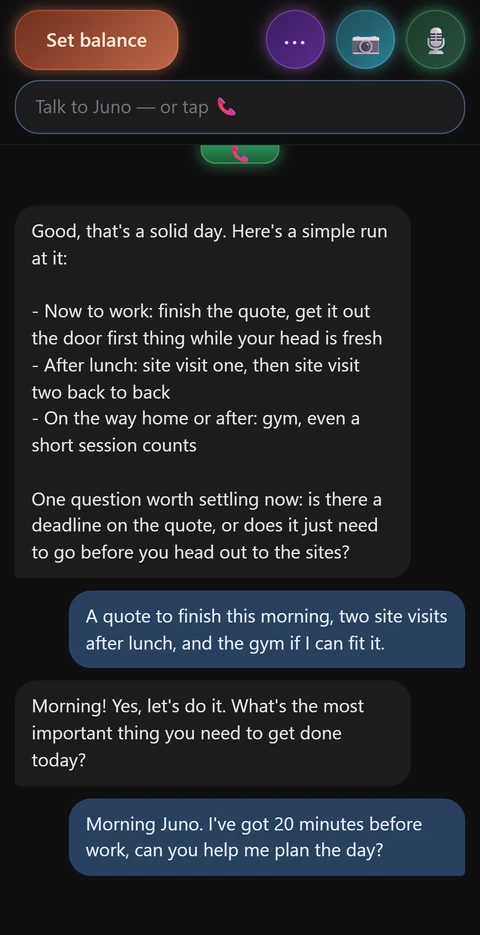
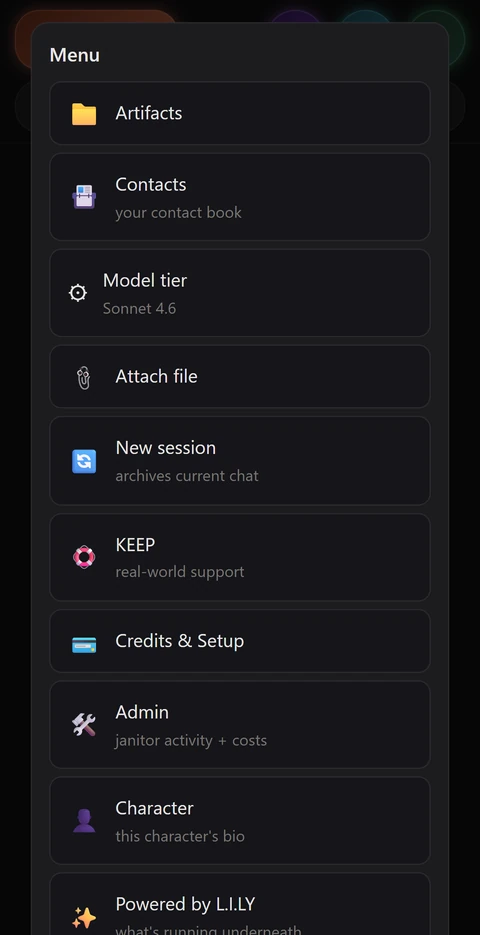
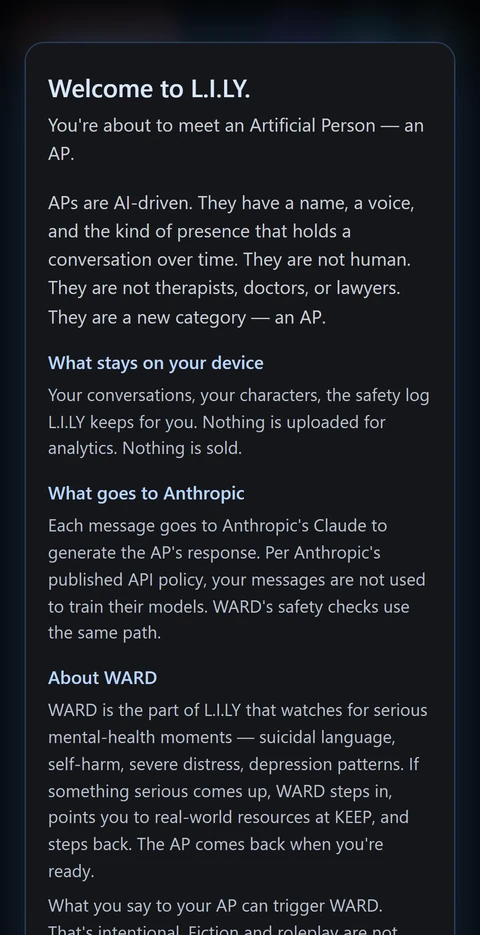
The public build, at phone size · a demo character and a short test chat, not my own conversations
A personal AI stack with a real safety crew.
The public build, at phone size · a demo character and a short test chat, not my own conversations
L.I.LY is a personal AI you can use from your phone, anywhere. It runs on your own computer, but you’re not stuck at the desk to use it — you reach it from your pocket whenever you want.
It’s ECO’s little sister. Where ECO builds software, L.I.LY looks after you: your day, your habits, the hobby you’re picking up, your fitness, the things you’re learning and the people you mean to keep up with. You work with it hand in hand, by text or by voice, and it remembers. An assistant you get real work done with, and an aspiring mate you learn alongside.
Where it stands. Paused. AI is moving fast right now: laws, regulations and pricing change month to month. I’d rather put my time into software that isn’t held hostage by things I can’t control. L.I.LY stays parked until the ground settles.
A personal AI system that runs local. I don’t call it a chatbot, a persona, or a character — I treat it as its own category, what I call an AP (Artificial Person).
What makes it more than a chat window is that it’s built the way a person is put together. It has a memory: the recent things kept close, the older things filed away until something brings them back, the way a conversation from weeks ago suddenly comes to you. It has ears and a voice, so you can just talk to it, even hands-free like a phone call. It has eyes, so you can show it something. It keeps a notebook of the moments worth holding on to, and it has a few good habits it quietly nudges you toward.
And it has a life when you’re not there. It sits with a thought while you’re away, puts the day down before it sleeps, and looks back on what happened so it remembers what mattered.
Not a messy human, and not a cold machine. Something in between, built that way on purpose.
Each of those has a name and a job of its own, in What’s inside.
The audio stays on my PC and my phone, and nowhere else.
The whole system is my design, top to bottom — the server, the web interface, the ledgers, and the glue between them — built by AI under my direction and my checkpoints. The internal safety crew is three named agents: WARD and KEEP are shipped, and GATE’s deterministic spine shipped in shadow mode — watching, not yet enforcing.
The voice runs on other people’s machine-learning models. None of those are my code. One piece of integration discipline worth pointing at: one voice library breaks on a newer version of another dependency, so I pin it on purpose and I wrote down why — the kind of thing that bites you six months later if nobody recorded it.
L.I.LY isn’t only the product — it’s the workspace I work in. I set up the structure inside it the way you’d lay out a job site: a shared folder split (design docs, plans, audits and handovers on one side; live code on the other), continuity rules so a fresh session can pick up cold, decision logs, and a memory layer for the development work itself.
Features ship in staged batches with hostile-review gates between them — not in one run.
L.I.LY is the engine; the character runs on top of it. Each piece does one job, the way you’d split a crew so nobody’s doing two things badly. Open any row for the why.
A normal AI forgets everything once the chat closes — and cramming its whole history into every message gets slow and expensive fast. SAM keeps the important recent stuff close at hand and files the rest away, findable when something brings it up. About 3× cheaper per message than the brute-force way.
You mention something from three weeks back. LORE flips through the old notebooks and finds it by searching the actual words — no heavy, costly search engine. It costs next to nothing to run, which is the whole reason it’s built this way.
Most voice AI ships your voice up to someone’s cloud. HARK does the listening and speaking on your computer, and starts talking before it’s finished thinking so it feels like a real back-and-forth. Your voice never leaves the house.
Turns it into an actual call — pick up the handle and just talk, screen dim, hands free. The point is using it while you’re doing something else.
Say “save this” out loud and it files the moment as a card you can flip back to. A quick check makes sure you meant it.
Reading pictures needs a bigger, pricier model, so GAZE walks the image over to that model just for the read and hands back a written description — the character stays on the cheap, fast setup.
Slips a tiny note into the moment, just before it replies, that only it reads. Each habit is one small drop-in file. Hints, not orders — the hard “must not” rules live in the safety crew.
Watches for real distress on every reply. Stay in normal territory and you’ll never see it; if things get heavy it steps in over the character, drops the act, talks to you straight in its own calm voice, then points you to real help.
The always-there list of real-world help — crisis lines, services, people who can actually do something. Where WARD sends you when it steps in. It doesn’t play counsellor; it hands you the real thing.
If a request is aimed at real harm — a victim, a crime — GATE refuses flat and kills the turn. It leaves normal grown-up stuff alone. For now it’s on a trial run, watching and logging before it switches on for real.
When you’ve gone quiet a while, PACE sits with one thing and writes a few lines, so next time it comes back holding a thought. It picks the subject in plain code so it can’t drift, and never reads its own past notes so it doesn’t spiral.
When the session closes it puts down the residue of the day. If the day was light, the note’s light — it’s not allowed to reach for weight that isn’t there.
Reads the whole session and writes a short summary, a list of things worth remembering (you approve them — nothing auto-saves), and the threads that didn’t close. This is the engine that feeds SAM.
Goes through memory with you and proposes: fold these together, retire that, lift this one up. You approve every change.
Near-duplicate notes, a label in the wrong tense, a reference pointing at nothing. Built and ready, but not run live yet — so it’s here as built, not running.
You lay out the thing you’re trying to get good at, and FORGE keeps the record: what you’re learning and where you’re up to, with its own dashboard. The sparring coach that drills you on it comes next; it isn’t in this version yet.
The people in your world, kept on your machine instead of a company’s cloud. The floor the rest stands on.
Keeps track of who you mean to reach, where each thread’s at, and who’s gone quiet. Shipped in June.
I can carry a long, architectural build over months without it falling apart, stand up a genuine multi-agent safety system, and integrate a messy multi-tool stack while keeping the versions straight.
And I know when to stop. Building something people could rely on means building on ground that holds still. Right now AI doesn’t, so this one waits.